WHO'S AFRAID OF VIRGINIA WOOLF? at Backyard Renaissance
It’s well past midnight when the games begin in Edward Albee’s “Who’s Afraid of Virginia Woolf?” —but in Backyard Renaissance Theatre Company’s gripping production, the emotional fireworks are just getting started. What unfolds over the course of a very long night is equal parts dark comedy, psychological chess match, and marital autopsy. The result is intense, frequently funny, and anchored by four excellent performances that make the evening as riveting as it is exhausting.
The story begins around 2:30 a.m., after a faculty mixer at a small New England college. Martha (Jessica John), the outspoken daughter of the university president, has invited the new biology professor, Nick (Drew Bradford), and his wife, Honey (Megan Carmitchel), over for drinks. Martha's husband, George (Francis Gercke), is an associate professor of history who seems perpetually stuck in academic limbo and was not informed of this plan. Still, he dutifully pours the drinks and welcomes the couple—though it quickly becomes clear that the night will be less fun nightcap and more gladiatorial arena.
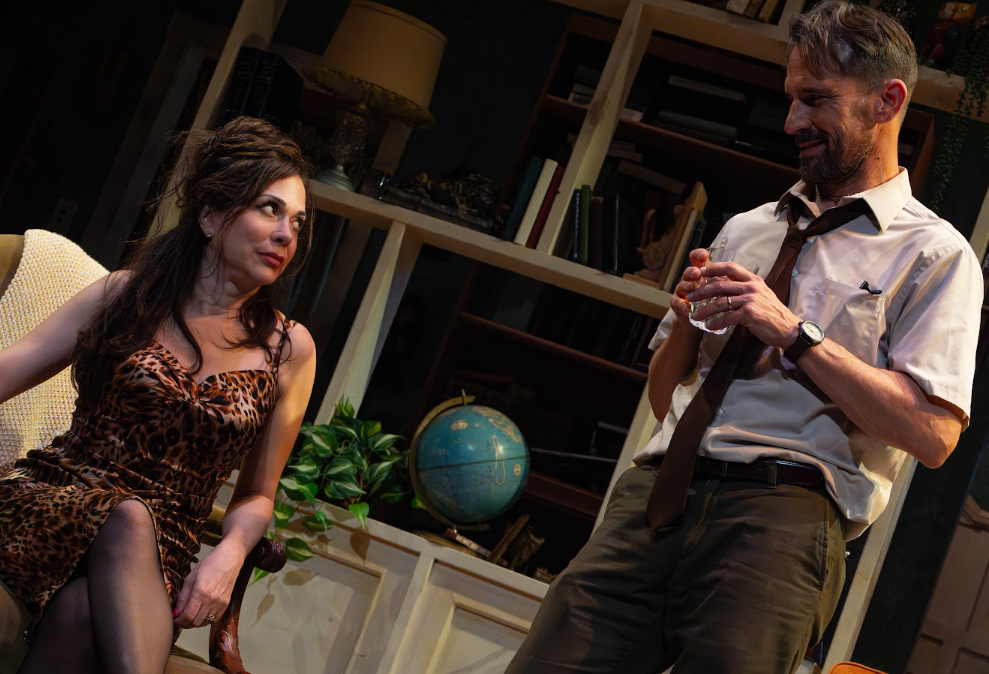
Jessica John and Francis Gercke- photo credit Michael Mackie
What begins as teasing banter between George and Martha soon escalates into a series of increasingly brutal “games.” Their guests, initially amused and confused, become unwilling participants as the couple’s long-simmering resentments, illusions, and emotional wounds are dragged into the open. Albee divided the play into three acts, "Fun and Games", "Walpurgisnacht", and "The Exorcism"- and this production leans fully into the shifting rhythms of those escalating confrontations.
While this play is often labeled simply as a drama, it is also surprisingly funny. George’s dry, cutting wit and Martha’s gleefully outrageous provocations generate frequent laughs. Yet that humor only sharpens the damage being inflicted. Beneath the sarcasm and theatrical cruelty lies an undeniable undercurrent of love, one that makes their mutual destruction feel even more painful to witness.
Jessica John delivers a commanding performance as Martha, moving effortlessly between brash confidence and moments of startling vulnerability. She dominates the room when she wants to, but the cracks in Martha’s bravado slowly reveal themselves as the night spirals on. Opposite her, Francis Gercke’s George is sly, cerebral, and quietly dangerous. While Martha may appear to swing the harder punches, George is the strategist of the evening, patiently setting traps with razor-sharp humor and unsettling calm.
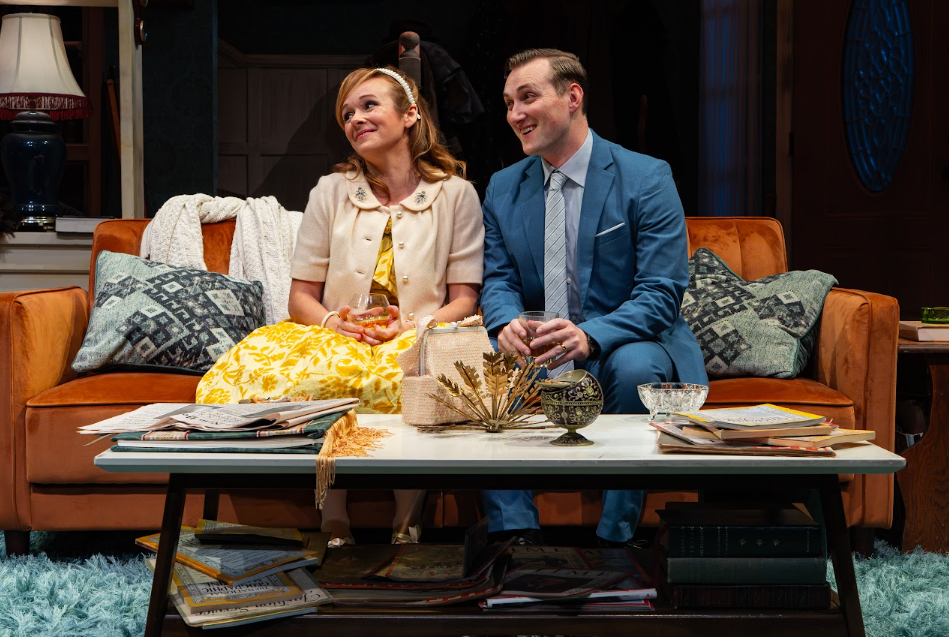
Megan Carmitchel and Drew Bradford- photo credit Michael Mackie
Drew Bradford is very strong as Nick, the ambitious young professor who gradually realizes he has wandered into a battlefield he cannot control. Bradford balances arrogance and bewilderment effectively as Nick’s confidence erodes over the course of the evening. Megan Carmitchel brings a fragile, often humorous innocence to Honey, whose sunny and polite façade masks deeper anxieties.
Co-directed by Coleman Ray Clark and Francis Gercke, the production maintains a steady pace and rhythm, allowing tensions to build, diffuse just enough to let the audience catch its breath, and then surge again as another wave of acerbic academic and emotional vitriol is unleashed. The staging and movement are carefully calibrated throughout, including the intricate choreography of the drinking itself — the endless glasses, refills, and offers that become their own kind of ritual. Glasses are refilled with the casual urgency of people who know the night will be long. By the time the sun threatens to come up, the four of them have put away enough liquor to make a fraternity house tap out early.
The production benefits from an impressively detailed set design by Chad Ryan, which places the audience squarely inside George and Martha’s cluttered 1960s living room. Books, furniture, and well-worn décor create a space that feels both lived-in and slightly suffocating, an environment perfectly suited to the emotional warfare taking place within it. Jeffrey Neitzel’s props reinforce the atmosphere, with an endless parade of glasses, bottles, and ashtrays suggesting that the characters’ coping strategy is, quite simply, more.
Sound and music elements add subtle tension throughout the evening, with Evan Hart Marsh’s compositions and Kamila Nunez’s sound design underscoring moments without overwhelming the dialogue. Brenna Maienschein’s costumes capture both the period and the characters’ shifting emotional states, particularly Martha’s evolving wardrobe, which mirrors the unraveling night and the blue and yellow of Nick and Honey’s outfits, which mirror the colors George and Martha often use to describe their son. This visual pairing adds another subtle layer to the evening’s central tension between illusion and reality.
At nearly three hours with two intermissions, ”Who’s Afraid of Virginia Woolf?” is undeniably a marathon. But in the hands of Backyard Renaissance, the journey rarely loses its grip. By the time the emotional dust settles, the audience—like the characters—may feel a bit wrung out. Still, Albee’s searing exploration of love, illusion, and the games people play remains as powerful as ever.
How To Get Tickets
”Who’s Afraid of Virginia Woolf?” by Backyard Renaissance is playing through March 21st at Tenth Avenue Theatre. For ticket and showtime information, go to www.backyardrenaissance.com