Interview: Charlie Barnett of HEDDA GABLER at The Old Globe
At the center of “Hedda Gabler” is a woman who refuses to be contained. Standing opposite her each night at The Old Globe is Charlie Barnett as George, the man who believes, at least at first, that he has built a perfectly reasonable life with her. Bennett is currently playing George Tesman in Henrik Ibsen’s “Hedda Gabler”, in a streamlined new adaptation by Erin Cressida Wilson and directed by Barry Edelstein. Tesman is often dismissed as fussy, oblivious, or weak, the academic husband too dull to understand the storm he has married, but Bennett had other ideas.
Ibsen’s 1890 drama centers on Hedda, newly returned from her honeymoon and already restless in her carefully arranged domestic life. Her husband, George Tesman, is an earnest academic on the brink of professional success. On paper, the marriage is ideal: stability, status, and a promising future. In reality, it is a slow collision between expectation and desire. Tesman is often portrayed as oblivious or weak, a foil to Hedda’s volatility. Bennett was determined to find something more.
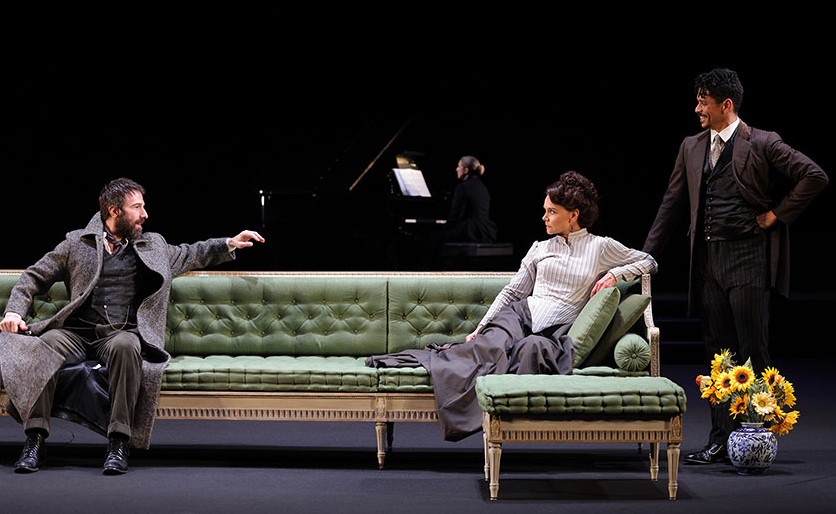
(from left) Alexander Hurt as Ejlert Lövborg, pianist Korrie Yamaoka, Katie Holmes as Hedda Gabler, and Charlie Barnett as George Tesman in Hedda Gabler, 2026. Photo by Rich Soublet II.
Barnett’s history with the play stretches back decades. “I think any play, even if you know it like the back of your hand, I think there's still so much to be explored,” he says. “You can read it a billion times and find something new in it from someone else's performance or from a different read at a different time and a different place in your own life.” Introduced to the play in high school and later studying it in depth at Juilliard, he remains fascinated by its impact. “At the time it came to the stage, people hated it. So it's always fun to know that something that was so viscerally objected to is living on.”
When this production came along, Barnett had not done a full play in years, but this adaptation felt like an opportunity he could not resist, even if the opportunity to return to Ibsen felt daunting and necessary.“I haven't done a full production of a play with a run for many, many, many years,” he says. “It's also one of those plays that feels like a mountain, and I wanted to climb a mountain.”
Several elements sealed the decision: Wilson’s adaptation, Edelstein’s direction, and the chance to work opposite Katie Holmes as Hedda. Holmes’s willingness to take on such a demanding role was an inspiration, Barnett says, “If Katie is willing to be vulnerable and risk and be excited to jump into something as dangerous and scary as Hedda, then I want nothing more than to be there to support her and to be a part of it.”
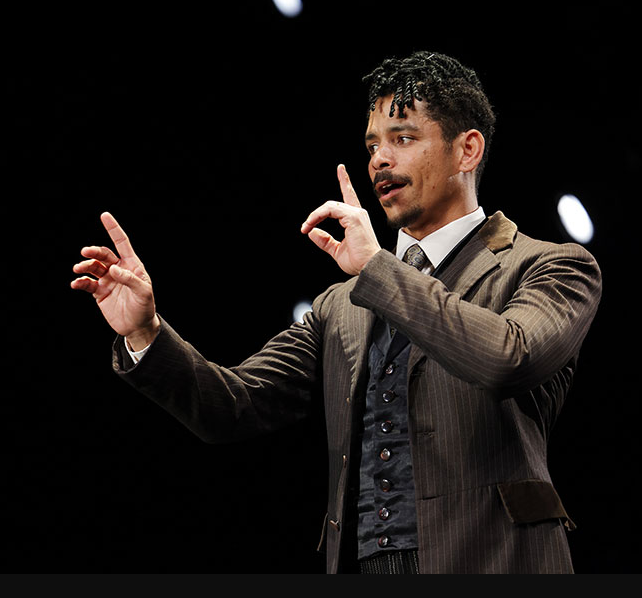
Charlie Barnett as George Tesman in Hedda Gabler, 2026. Photo by Rich Soublet II.
But ultimately, it was George's character that hooked him. “George Tesman is historically a difficult character to play,” Charlie says. He wanted to resist the traditional interpretation. “I wanted him to be as precise and as sharp as he is as a professor as he is as a historian. Someone who is handsome and strong and has some actual sexual drive and interest.” More provocatively, he wanted to explore a version “in which he had everything on page, and she still wasn't happy.”
That reframing shifts the dynamic. Charlie sees George as someone raised by his aunts, drawn to Hedda’s steel and certainty. In his reading, George is not clueless so much as mismatched—earnest, striving, and unable to comprehend why the life he has built is not enough.
One of the production’s most striking elements is the live music threaded throughout, performed onstage, which Charlie recalls initially wondering how it would be incorporated, “When music came in, we were all like, what is this? What's happening?” Now, he cannot imagine the show without it. “Every production of every show should have music, even if it's not a musical.”
He is quick to praise pianist Korrie Yamaoka, calling her “the embodiment of Hedda” and noting how essential that layer has become to the storytelling.”Katie, of course, should get roars of applause because she's on that stage the entire night. But Korrie, our pianist, also gets just as much, and I'm so glad that she's getting the recognition that she absolutely deserves.”
Performing the role nightly is its own challenge. “Every day it changes, and every day we're able to kind of look at it in a new or different light,” he says. The work demands vigilance. “I still feel like I walk the tightrope every single day.”
Unlike a screen project that wraps and moves on, stage performance demands maintenance—physical, emotional, and technical—over weeks. “It's an entirely different stamina. I'm starting to learn how to maintain, make it new, and make it fresh.”
That ongoing evolution is precisely what keeps him engaged. It is messy, collaborative, and alive.
As the run continues, Barnett remains grateful. “I thank San Diego for giving us this chance to do something that's risky.”
In a season that includes bold programming, he adds, “I think the Globe imagined a world in which Hedda Gabler and Bartleby, two incredibly obscure shows to a mainstream audience, are being uplifted and successful endeavors in an American market, and that is so heart-warming to me. In my own sense of joy and trying to find my place in this art again, I could not have had a better experience. I thank every audience that has come, every person I have had a chance to work with, and The Old Globe and San Diego in general for taking risks, trying something, and making it adaptable for an audience of this day and age. It’s beautiful how they’ve stuck to the roots and found a new outlet for it.”
How To Get Tickets
“Hedda Gabler” is playing at The Old Globe through March 22nd. For ticket and showtime information, go to www.theoldglobe.org