What happens when you take a young man, break him down, build him into a soldier, and then send him to war? What parts of his humanity survive the process, and what happens when the lines between duty, loyalty, violence, and personal responsibility become blurred? OnWord Theatre’s 9 Circles, written by Bill Cain, takes on these uncomfortable questions in a gripping production that blends fact and fiction with the nine circles of Dante’s Inferno. Based in part on the true story of U.S. soldier Steven Dale Green, this is not simply a story about the horrors of war or the crimes committed in its aftermath. It examines what war does to the people sent to fight it, and the complicated truths that remain when they come home.
The story follows Reeves (Eli Wood), a young soldier who wakes up in a U.S. holding cell with little memory of how he got there. Accused of horrific crimes against Iraqi civilians, including rape and murder, Reeves insists on his innocence of those offenses while acknowledging guilt in others. From the fury of Baghdad to the loneliness of the holding cell, this is the story of a soldier’s life that has always, on some level, felt solitary and imprisoned. His journey through the military and civilian justice systems becomes a hellscape battle of blame and beuaracuracy in its own right.
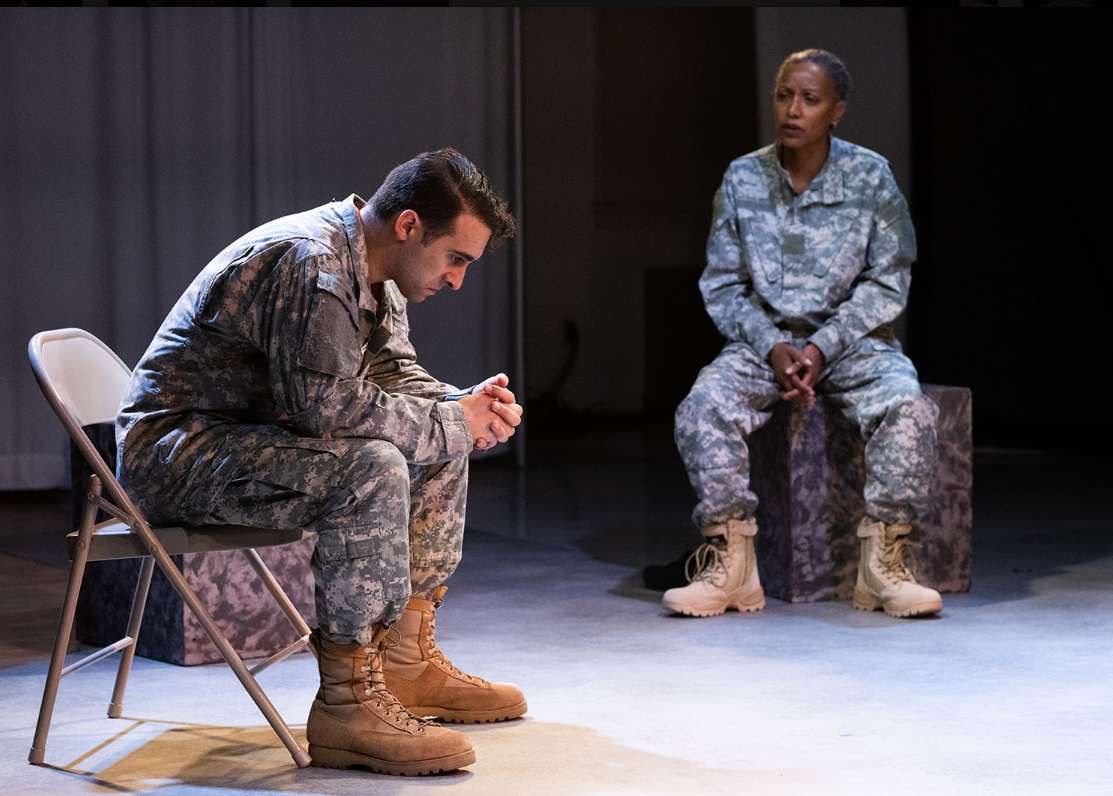
L- R: Eli Wood and Marti Gobel
Photo Credit: Bernadette Johnston of Narrative Images
Wood is excellent as Reeves, delivering a roller coaster of energy, emotion, and shifting truths. Once the show begins, he never leaves the stage, in an emotional and physical marathon that carries the production from beginning to end. At first glance, Reeves might seem like a gung-ho, no-remorse, no-thinking soldier - happy to do damage and/or kill in the name of feeling like he is part of something, but there is considerably more beneath the surface. Early on, when a lieutenant comments that Reeves is pretty smart “for a grunt,” Reeves responds with quick wit and a Texas drawl: “That was not the consensus of opinion of the faculty at my high school, sir.”
Wood navigates Reeves' contradictions deftly, moving between humor, vulnerability, anger, and frightening unpredictability. As time, place, and motivations shift, Reeves never quite manages to sit comfortably in his own truth until the moment he can no longer pretend. It is a demanding performance that requires extraordinary stamina. Along the way, Reeves encounters people who may help him understand what he has done, challenge his version of events, or force him to consider whether he is responsible for his actions or simply a product of the circumstances around him.
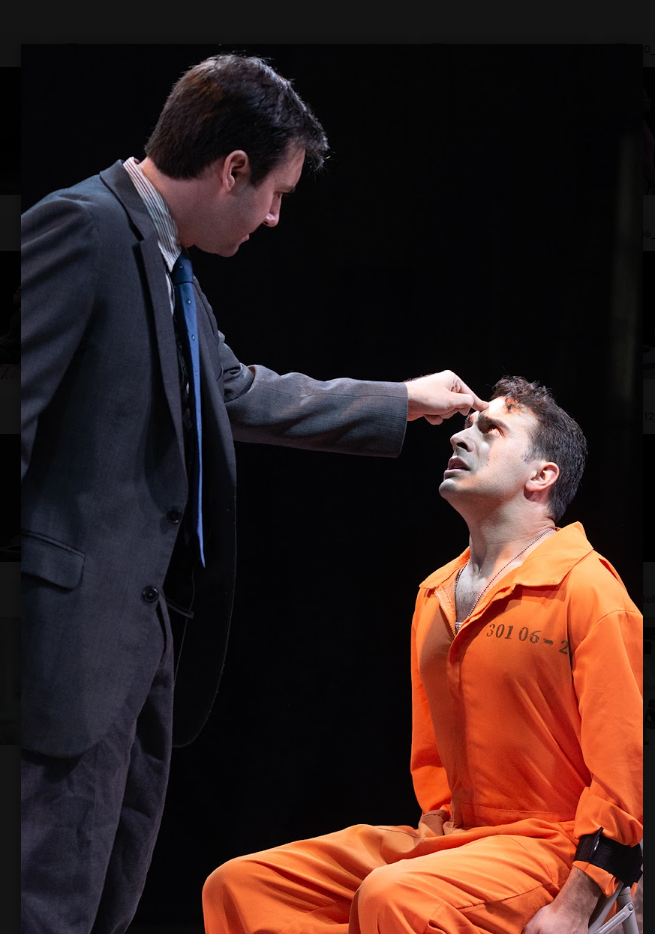
L- R: Tanner Vydos and Eli Wood
Photo Credit: Bernadette Johnston of Narrative Images
The ensemble is equally strong, with Asmar Fontenot, Tanner Vydos, and Marti Gobel taking on multiple roles throughout Reeves’ journey through the circles of hell. Fontenot, Vydos, and Gobel move effortlessly among their various characters, giving each a distinct personality, perspective, and objective. Fontenot brings engaging curiosity and conversational confrontation, Vydos shifts convincingly between authority and advocacy, and Gobel adds dimension to characters on both sides of Reeves’ journey. The multiple-character performances are particularly effective, with each encounter bringing a different lens through which to examine Reeves and his circumstances.
Cain’s writing has a distinctly Jesuit sensibility: practical, worldly, contemplative, and empathetic, which makes sense given that he is a Jesuit priest. Rather than offering easy answers, he asks difficult questions about the cost of war, the transformation of a boy into a soldier, and what might be lost in the process. In training, recruits are stripped down and rebuilt to be as effective as possible in their assigned roles. But what happens when, for some, what was lost can never be fully restored? Who is ultimately responsible: the person who commits the acts, or the system that helped create them?
Despite the subject matter's seriousness, Director David Cesarini also understands the importance of letting the audience breathe. The production finds moments of humor in Cain’s writing and in the actors’ performances, often arriving just when the tension needs a release. These moments never diminish the story's gravity; instead, they make the characters more human. Michael Wogulis’ spare scenic design, turning the Light Box Theatre into a theatre in the round, consisting of a circular playing space, a chair, and a few boxes, allows the action to exist anywhere and at any time. Zane Shrem-Besnoy’s lighting complements the shifting environments, while Danielle Bunch’s costume design enables the actors’ quick, effective transformations.
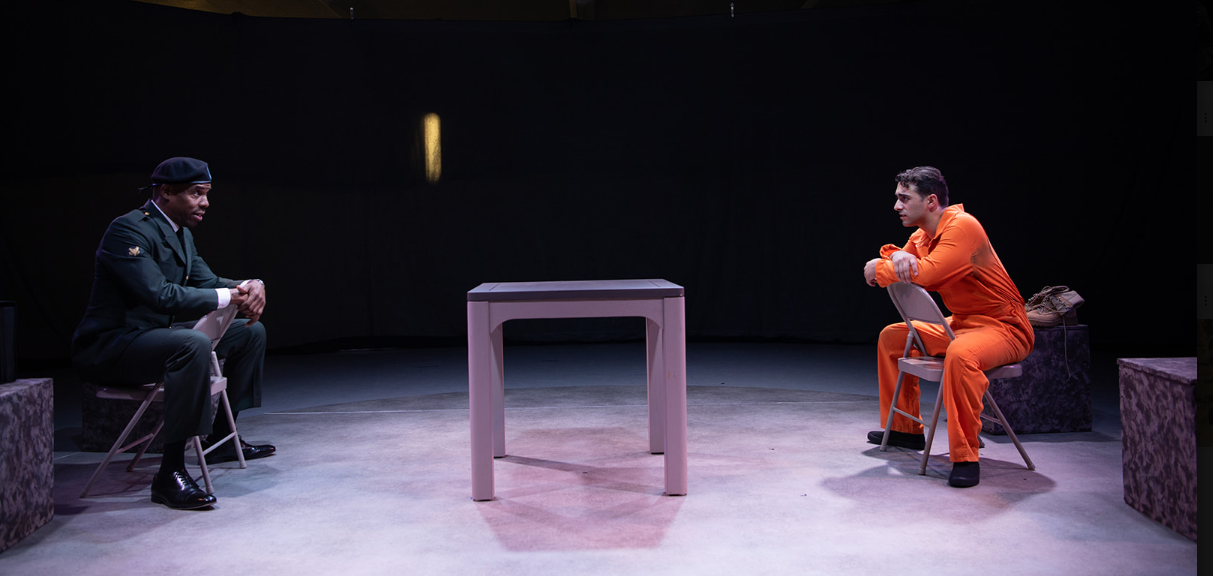
L- R: Asmar Fontenot and Eli Wood
Photo Credit: Bernadette Johnston of Narrative Images
Experiencing this production at Liberty Station adds poignancy, where generations of military personnel trained and prepared to go out into the world with their orders. Having grown up in a military town, with friends and family who have served, I have seen both the honor and the cost of military service. I have watched young boot camp graduates celebrate with freshly shorn heads and puffed-out chests, talking about becoming heroes and the glory of going to war. I have also seen the quieter relief of those grateful simply to be home. 9 Circles holds space for both realities.
9 Circles is not an easy evening of theatre, nor should it be. With strong language, depictions of violence, and some nudity, it may be disturbing for some. But its questions linger long after the final scene. This is challenging, thoughtful theatre that asks us to consider not only what war does to people, but what we ask of them in the name of service, and how much of ourselves we can lose along the way.
How To Get Tickets
9 Circles plays at OnWord Theatre through November 22. For more ticket and season information, go to www.onwordtheatre.com